By Ryan Pettijohn and Gregg Shepperd

For years, the equation for closing the digital divide or scaling competitively seemed binary. Internet service providers (ISPs) either had to absorb the capital-intensive deployment costs of a direct wireline or fiber build or risk potential performance issues with unlicensed spectrum. Recently, a third option has begun to emerge that involves hyperlocal ISPs partnering with national operators.
In this new model, operators provide shared and lightly licensed spectrum, typically via fixed wireless access (FWA), to the local ISP that use the added spectrum to offer new or expanded services to its customers. In return, the operator receives access to the ISP’s on-the-ground infrastructure, resources and experience. The result is an open-access, hybrid network that gives customers more choices while reducing deployment time and cost for the operator and ISP.
These open-access network partnerships are also gaining traction among network investors. By drastically shortening the path to profitability, the new arrangement enables private equity, venture capital and infrastructure funds to de-risk capital deployment while unlocking high-margin, previously unreachable regional markets.
“By separating the roles of network owner and service provider, open access networks aim to foster competition, lower costs, and expand broadband coverage.”
— Broadband Now, April 2025
Anatomy of a Hyperlocal Partnership
In a successful partnership, national operators and regional or local ISPs share equally in the benefits. National carriers hold valuable, licensed spectrum rights but often lack the granular community trust and localized truck-roll efficiency required to optimize subscriber acquisition in secondary or rural markets. Conversely, ISPs and local operators possess deep roots and rapid deployment capabilities, but buying or clearing nationwide licensed spectrum has historically remained cost-prohibitive.
The partnership bridges the gap between the two. The national operator ensures robust signal integrity, high throughput and interference mitigation through standardized cellular frameworks, while the local ISP manages the subscriber relationship, leveraging high consumer satisfaction metrics associated with localized FWA performance.
Keys to Success for Operators and Investors
For this model to deliver on its financial and operational promises, stakeholders must address three core challenges:
Spectrum quality and interference control: To compete with wireline alternatives, operators must ensure high-capacity throughput by improving spectrum quality and interference control. Coordinated spectrum planning and management help mitigate interference, while use of standardized bands such as Band 48 and CBRS helps protect spectrum quality by enabling economies of scale when manufacturing white-box hardware and components and improving interoperability.
Unified multi-tenant management: In the absence of end-to-end 5G network slicing, local, multi-tenant ISP partnerships often use logically separated network resource layers to manage the ecosystem. Network visibility under these circumstances can quickly fracture. A single pane of glass is required to monitor wholesale performance without compromising individual operational boundaries.
Operational disaggregation: Implementing a modular architecture can increase flexibility, vendor choice and opportunities to reduce capital costs. However, these benefits are realized only when paired with effective systems integration and orchestration. This has led to the development of robust open-access management platforms that can simplify both multi-vendor network operations and lifecycle management.
The Role of Open-Access Management Platforms
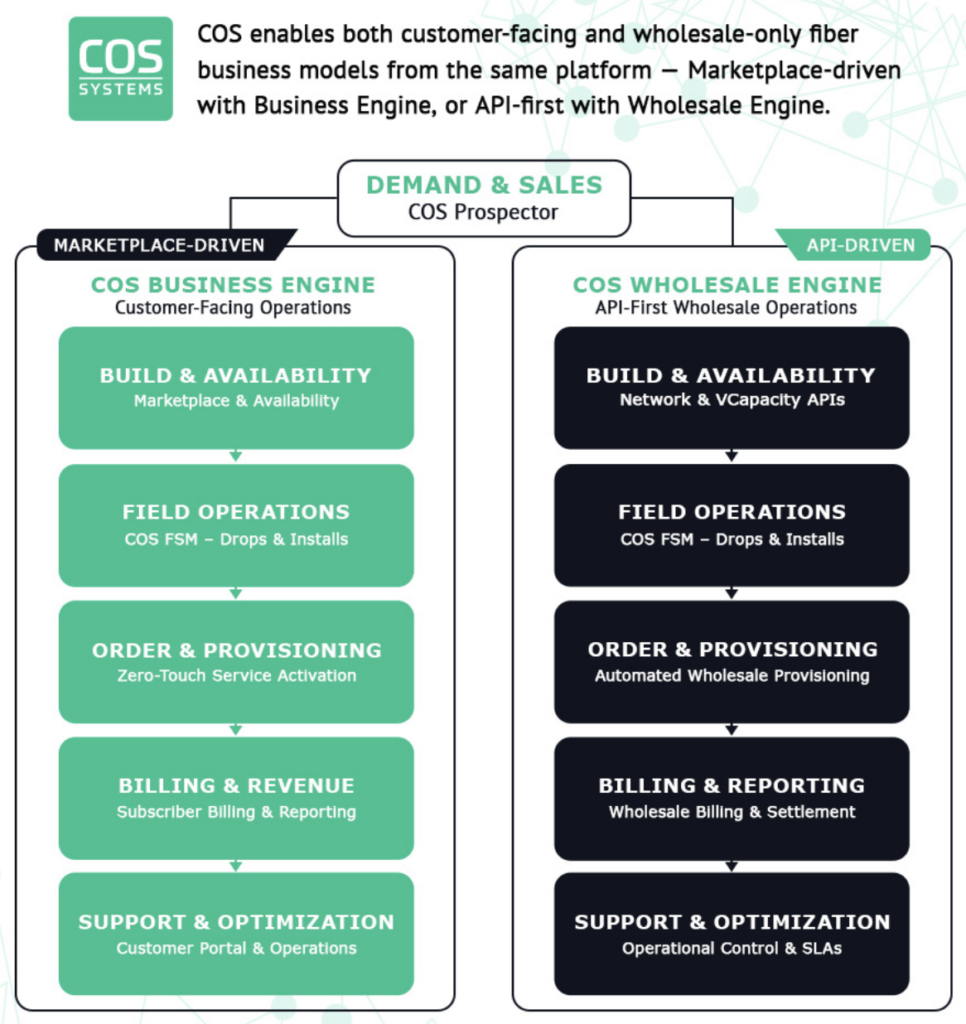
Managing multiple service providers on a single physical or spectral network requires advanced system automation and intelligence. The 1Finity Broadband Open Access Management (BOAM) platform is a specialized network orchestration solution that eliminates the administrative chaos of multi-tenant wholesale environments. Powered by the COS Business Engine, it enables network operators to manage complex operations, including multi-ISP provisioning, service activation and operations across shared, open-access fiber and hybrid infrastructure.
For example, the BOAM system enables infrastructure owners to host and manage multiple distinct ISPs on one underlying platform architecture. It gives operators a holistic, real-time view of aggregate bandwidth utilization, wholesale revenue distribution and sector capacity health across the business ecosystem. The platform’s strict operational partitions give each participating ISP oversight over its customer base, enabling them to gauge local interest and pre-register demand for upcoming fiber or wireless passes.
To customers, the operational loop is completely transparent. During service interruptions or performance issues, they can seamlessly generate digital support tickets that are routed directly to their ISP for rapid triage, helping ensure the ISP’s responsiveness and brand remain measurable and strong.
The Bottom Line for Operators and Investors
The convergence of national-grade licensed spectrum with hyperlocal service delivery represents a high-margin, highly scalable frontier in broadband delivery. By removing the traditional barriers of spectrum acquisition and deploying unified open-access management platforms, operators can achieve optimal asset utilization and lower total cost of ownership. For investors eyeing the next evolution of digital infrastructure, backing ecosystems powered by collaborative, software-managed open access is no longer just an alternative strategy — it is a clear roadmap to sustainable market leadership.
Find more information about the 1Finity Broadband Open Access Management platform here.

Gregg Shepperd
Gregg Shepperd serves as the Senior Solutions Management Engagement Leader at 1Finity America, Inc. He is a technology leader with 36 years of experience in networking solutions and broadband markets. Gregg specializes in broadband operations solutions and leads the development of Day 2 operations and maintenance strategies for broadband network builds. His work leverages 1Finity’s Network Operations Center, OSS/BSS platforms, and field maintenance solutions to support reliable, scalable network operations.