
Broadband network operators and access providers face a host of operational hurdles: accelerating speed to market to outpace competitors, overcoming the grueling logistical and financial barriers of last-mile deployment, and establishing sustainable network monetization strategies that can justify massive capital expenditures—to name just a few.
It’s becoming clear that these issues can’t be solved within a single-technology framework. Operators must rethink how networks are designed and deployed. And they are.
Operators, access providers, and their investment partners have begun moving away from rigid, single-technology frameworks and toward open-access hybrid models. By strategically blending open-access networks, pure fiber, and fixed wireless access (FWA), operators can build highly adaptable ecosystems. However, this multi-faceted approach comes with its own distinct set of trade-offs.
The complexity of these issues was on full display during Open-Access Day 2026, the annual gathering for operators, ISPs, and infrastructure investors that took place as a pre-conference workshop at Fiber Connect 2026. Four panelists—Iswar Tripathy (1Finity), Rob Johnson (Prime Fiber), Craig Walton (AT&T), and Jonathan Van (Element 8)—discussed the challenges and opportunities of hybrid networks with each other and the panel moderator, Isak Finer (COS Systems).
Three implications emerged from the discussion:
- Hybrid models are driven by economics, not preference.
- FWA is becoming viable at scale but introduces variability.
- Operation integration and management, not deployment, are among the biggest challenges.
Market trends make fiber-only broadband a tough sell
For Tier 1 carriers, traditional fiber remains the gold standard but is not without its challenges. Terrestrial fiber deployment, especially in the last mile, can be slow, capital-intensive, and operationally expensive. For open-access providers (OAPs) and Internet service providers (ISPs), these issues are playing out in the field.
- Time to market: The broadband sector is aggressively competitive as they seek to satisfy surging customer demand for new fiber and upgraded services. As well-financed competitors rapidly expand into legacy carrier markets, many ISPs are partnering with OAPs. This allows ISPs to bring new services to market faster without building local infrastructure from scratch.
- Monetizing rural, exurban deployments: In rural, exurban, or fringe areas, the math for terrestrial fiber breaks down. At a standard retail price point (e.g. $70/month), carriers cannot achieve an acceptable return on investment (ROI) given the high cost per mile of laying fiber. This makes fiber-only expansion financially impractical in many of these markets.
The convergence of these and other issues is forcing ISPs to consider integrating alternative technologies, primarily FWA, to bridge digital divides efficiently.
What FWA brings to the party
By utilizing existing cellular infrastructure, FWA operators can deploy services across vast geographic areas in a fraction of the time it would take to run hundreds of fiber connections from the street to the premise. This allows both operators and investors to drastically accelerate their time-to-market and rapidly expand their coverage footprints. Upfront deployment costs for FWA are also significantly lower and subscriber onboarding is much faster. This enables service providers to reduce capital expenses (CapEx) and operating expenses (OpEx) while monetizing network assets almost immediately. The result is a much faster and larger return on investment (ROI).
If there is a knock on FWA technology, it’s that its performance can fluctuate due to shifting line-of-sight constraints, changing seasons, weather patterns, and even growing foliage. To elevate fixed wireless to a standard acceptable to a Tier 1 carrier, hardware vendors have driven massive technological breakthroughs that enable substantial capacity increases.
Among the developments is support for multi-user, multiple-in multiple-out (MU MIMO) technology. Legacy FWA serves one user at a time per channel, forcing a queue. FWA with Multi-User MIMO (MU-MIMO) allows a cell tower to transmit to multiple stationary customer premises (CPEs) simultaneously on the same frequency. This spatial multiplexing typically yields a 50% to 75%+ increase in average throughput and 2x to 3x multi-user capacity gains.
Another advancement has been the ability of next-gen FWA to take advantage of Software-Defined Networking (SDN), Network Functions Virtualization (NFV), zero-touch provisioning, and network slicing. These tools isolate bandwidth slices to ensure predictable quality of service and low latency, mimicking the stability of a physical fiber line.
While these advancements make FWA increasingly viable; they also introduce variability that — unlike the predictability of fiber — operators must actively manage.
Challenges of open-access integration
Although multi-technology open-access networks offer many benefits in terms of customer choice and business diversification, there are underlying technological and operational differences that can introduce complexity. These differences don’t just create technical complexity. They introduce inconsistencies in provisioning, monitoring, and customer support, making it difficult to operate a unified network at scale.
For example:
- In terms of serviceability, fiber requires physical proximity to network access points, while fixed wireless access relies on a line-of-sight connection.
- Fiber addresses are often static and linked to physical ports, whereas fixed wireless access uses dynamic allocation or carrier-grade Network Address Translation (NAT) addressing, depending on the RAN architecture.
- When provisioning the network, fiber activation involves configuring optical network terminals (ONTs) and physical splicing. Fixed wireless access provisioning, on the other hand, focuses on customer-premise equipment (CPE) alignment and spectrum authorization.
- When it comes to quality of service (QoS), fiber typically offers consistent, symmetrical throughput, while fixed wireless access QoS can be variable and operate at lower speeds versus fiber.
Then there is the issue of resolving differences in network management approaches. ISPs typically favor a “lit pipe” or fully managed service model over “dark” infrastructure when partnering outside their native footprint.
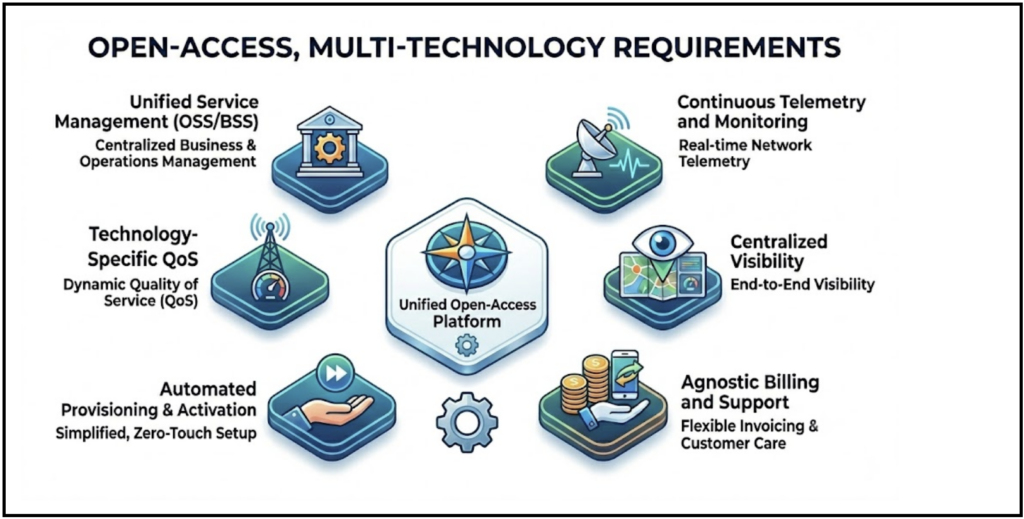
Because a national carrier may lack local warehouses, service vans, or local technician relationships in a new, and especially rural, market, it relies on the OAP to handle everything from tower management to final in-home installation and hardware dispatch. ISPs do not want to police the internal mechanics of a third-party wireless network. Instead, they want clear Service Level Agreements (SLAs) and unified, automated data boundaries. If a customer experiences an issue, carrier care teams require enough visibility (such as pushing a button to trigger a remote reset) to resolve the most common complaints, keeping customer satisfaction high while preventing expensive field technician dispatches.
This level of system integration requires advanced abstraction and network visibility. This where a robust broadband open-access management platform is critical.
The secret to creating and maintaining a successful open-access hybrid network
Addressing this complexity requires more than adding new technology. It requires a unified operational layer that can abstract differences and coordinate network activity across environments.
1Finity’s Broadband Open-Access Management (BOAM) Services solution helps ISPs and OAPs manage multi-technology, open-access networks for maximum operational efficiency. It combines 1Finity’s Network Systems Integration services, Managed Network Services, and the COS Systems Business Engine.
During network design, 1Finity uses its vendor-neutral, technology agnostic approach and expertise in network systems integration to properly size and configure the network based on the customer’s current and future objectives and technology roadmap.
Managing a network with multiple ISPs presents its own set of challenges, including increasing operating costs. There are wholesale billing, service activations and deactivations, and customer support that must be performed across all ISPs. Additionally, to optimize investments, network planning must also be highly targeted based on where subscriber demand is growing the fastest.
Within the BOAM Services platform, the COS Systems Business Engine provides the critical Operations Support Systems (OSS) and Business Support Systems (BSS) integration and customer service automation that allow network owners and operators to monetize their network assets. The cloud-based platform interconnects critical processes across multiple operational platforms, from service ordering and activation to billing. By automating the complex functions needed to sell, activate, and bill for all services offered by the network, the Services Business Engine improves the customer experience while significantly reducing operational costs.
Toward an open and integrated broadband future
As network operators and broadband service providers face growing competition, supply chain constraints, and shrinking profits, there is an ever greater need to reduce total cost of ownership and increase both speed and innovation to deliver profitable new services. The commercial and operational benefits of an open-access model help enable these goals across a range of network technologies and hybrid builds.
Increased deployment of multi-technology open networks sets the stage for an important network transformation that enables network operators, ISPs, and investors to reduce costs, speed innovation, boost performance, and strengthen the supply chain. Achieving this, however, requires a well-coordinated management platform that can integrate and align the various technical and operational capabilities and protocols of fiber ISPs and their FWA partners.
By bridging the operational divide between wireline fiber and wireless FWA infrastructure, the BOAM solution ensures that shared networks can scale smoothly, remain financially viable, and support vibrant retail competition.
As hybrid networks become more the norm, the ability to integrate operational overlays between technologies in order to manage and monetize them as a single portfolio will determine which operators can scale efficiently and remain competitive.