
Highlights from FYUZ 2025
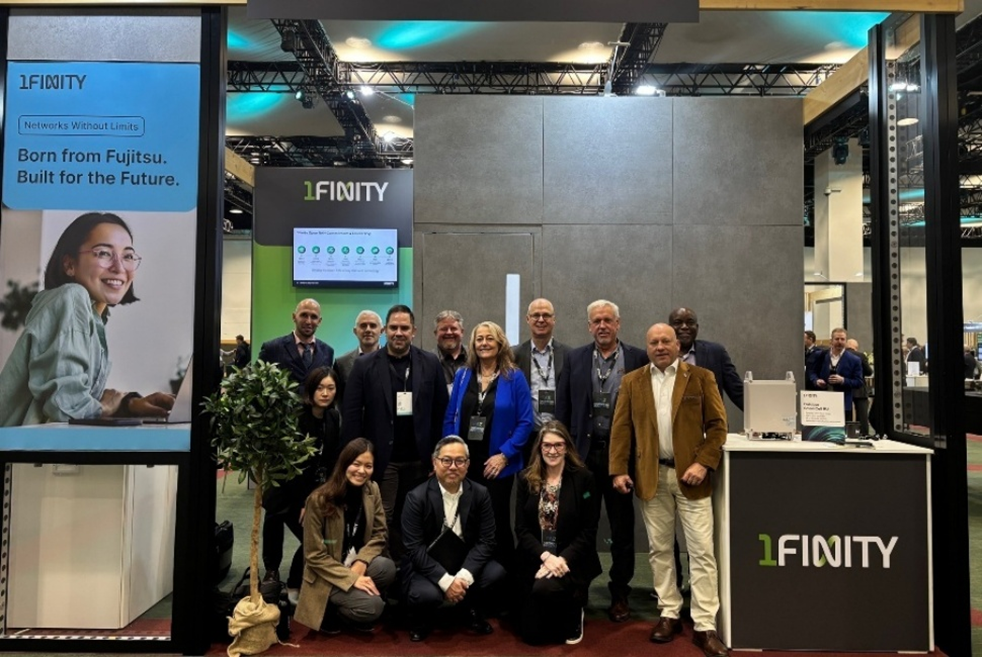
The Telecom Infra Project’s (TIP) annual FYUZ conference has always been a great event for those interested in Open RAN. But this year in Dublin, something felt different. FYUZ 2025 was quieter, less dramatic, and far less contentious than previous years. And to me, that is the strongest signal yet that Open RAN is no longer an experiment, a risky bet, or a philosophical debate. It is mainstream.
While the initial adoption of Open RAN was undeniably slower than early industry predictions, that’s not unusual. Adoption of new technology rarely happens on the timelines imagined during the hype phase. But as we’re now seeing, Open RAN has been evolving at a steady, healthy pace as more operators choose to deploy open, programmable networks that position them for AI, automation, and long-term flexibility.
For the first time, the energy at FYUZ 2025 wasn’t consumed by questions like, “will Open RAN perform as well as traditional RAN?” or “is it secure enough?” or “will operators really deploy it at scale?” Those conversations, which dominated past FYUZ conferences, were largely gone. In their place, we saw large Tier-1 operators discussing deployment successes, scaling plans, multivendor roadmaps, and the next layer of innovation.
As Head of Wireless Marketing for 1Finity, this shift was extremely satisfying. It aligned with everything we’ve been building toward: openness, flexibility, vendor diversity, and the integration of intelligence and automation into the network.
Tier-1 Operators Signal a New Era of Confidence in Open RAN
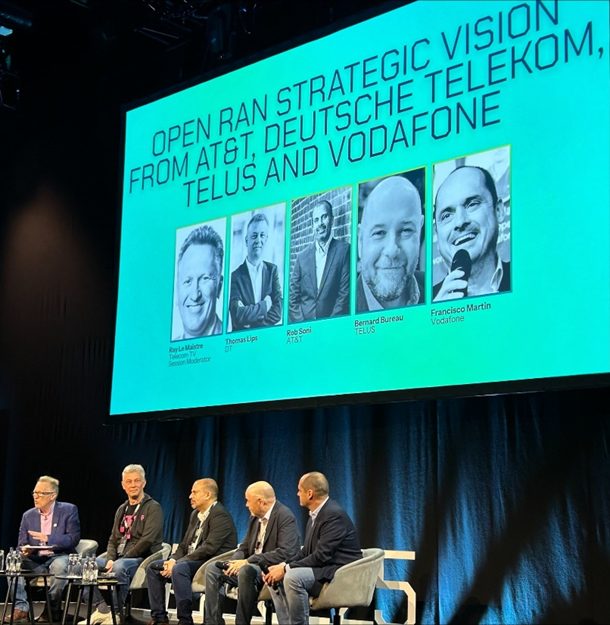
One of the most powerful moments of the week came during a keynote session where several Tier-1 Mobile Network Operators (MNOs) shared their Open RAN experiences on stage. I’ll admit I wasn’t expecting what came next.
Half of the operators specifically thanked 1Finity for the work we’ve done to advance Open RAN. But what really struck me were the concrete statements of confidence. Given the recent announcement that Vodafone had selected 1Finity for Open RAN deployments in multiple countries, I started to hope we would get three quarters of the panel endorsing us.
Fortunately, Thomas Lips, Deutsche Telekom’s SVP of RAN Disaggregation and Enablement, said something that encapsulates the entire mood of FYUZ:
“I can only say kudos to Nokia… and 1Finity. They’re doing a fantastic job. We are getting a quality that is on par and better than the supplier we are swapping out… so what we are seeing is fantastic.”
And then, just to underline how real this movement is, he announced that Deutsche Telekom’s Request for Quote (RFQ) for 30,000 Open RAN sites will begin in 2026. This is exactly the type of moment the industry has been waiting for. Open RAN isn’t a future promise. It’s a proven path forward.
Technology Pathways for Open RAN Evolution
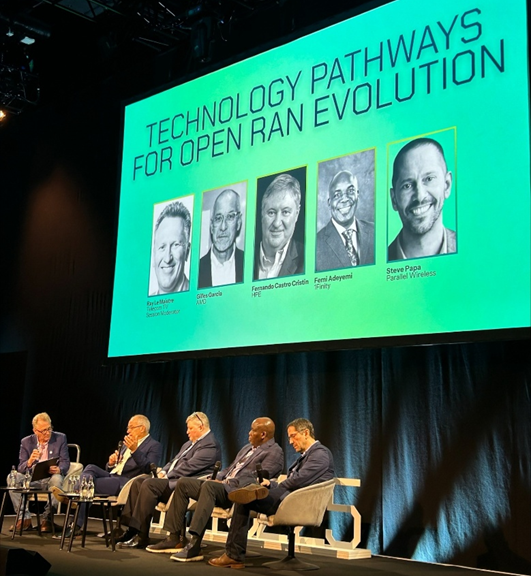
As Open RAN and AI-RAN evolve, transport networks must evolve with them. One message we heard was the necessity of IP-over-DWDM and intelligent automation to support these future architectures.
It is clear that the industry is now prioritizing scalability, efficiency, and intelligent automation as they evolve their RAN strategies.
AI-RAN: The Next Frontier
One of the most important messages at FYUZ 2025 came from Rob Soni, TIP Chairman and AT&T’s VP of RAN Technology, “There’s no AI-RAN without Open RAN.”
This statement captured a key industry truth that AI-RAN fundamentally depends on open, programmable architectures that allow AI workloads to run at and be monetized from the edge.
Many operators are already exploring AI for operations, including smarter power-saving applications, troubleshooting acceleration, and anomaly detection. This operational foundation is important as it can deliver immediate results, but the real shift is happening as operators begin viewing AI as a revenue-generating capability, not just an efficiency tool.
Several MNOs are going beyond that and are starting AI-RAN trials to explore performance improvements and understand potential commercial models. A natural starting point is enterprise customers, where the initial investment is modest and revenue models are clearer. This creates ideal conditions for MNOs to ease into AI and (most importantly) learn.
Real-World Open RAN: Ericsson + 1Finity at AT&T
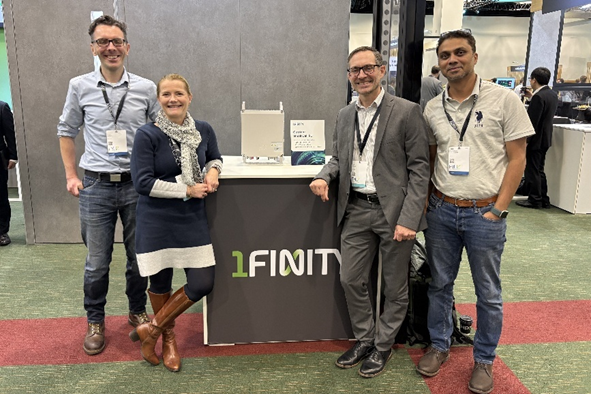
For us, one of the most exciting developments talked about at FYUZ 2025 was the collaboration between 1Finity and Ericsson that resulted in completing the first Open RAN call on AT&T’s live commercial network using our O-RAN-compliant outdoor small cell as announced by AT&T last month.
For years, the industry has been waiting for a Tier-1 operator to blend incumbent and new ecosystem vendors in a brownfield RAN with common multivendor management. Now it’s real.
Discussion of the project drove a steady stream of operators and others in the industry to our booth, all wanting to see the exact small cell we used in the AT&T deployment.
Building the Intelligent Transport Layer: IP-over-DWDM, Automation & Digital Twin Foundations
As Open RAN and AI-RAN evolve, transport networks must evolve with them. One message we heard was the necessity of IP-over-DWDM and intelligent automation to support these future architectures.
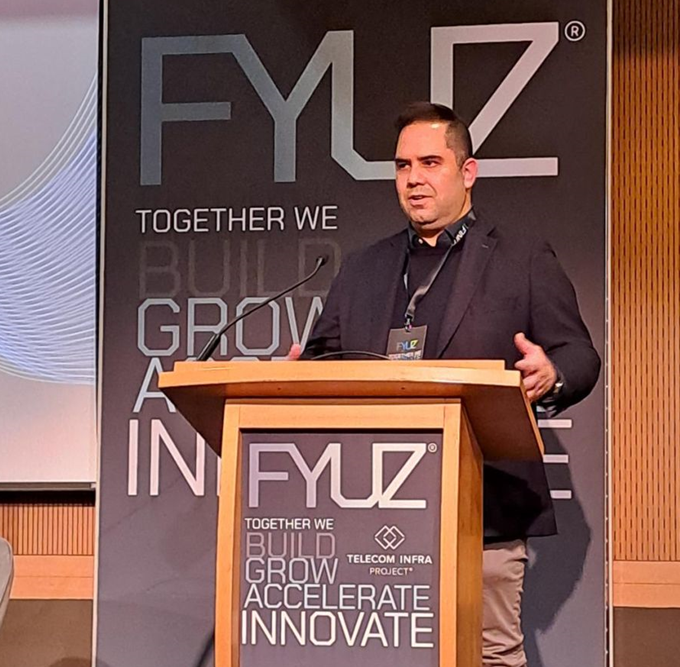
1Finity’s Head of Business Development for Emerging Technologies, Anthony Laboy highlighted a simple but important truth, “You can’t act on what you can’t see.”
Whether enabling multivendor optical domains, optimizing wavelengths, or laying the groundwork for future digital twins, three elements are essential:
- Instrumentation: Rich, high-resolution telemetry directly from optical hardware
- Analysis: Tools that convert telemetry into insight
- Control: Standardized, open interfaces that allow safe, automated action
These capabilities help operators automate wavelength planning, reduce operational risk, and make transport networks more adaptive. This type of openness in transport mirrors what we’re doing in Open RAN. Multivendor integration is not a barrier. It’s becoming the industry norm.
Beyond Macro: Small Cells, Private Networks & Deployment Diversity
I also had the opportunity to participate on stage where I highlighted our work with Ericsson on small cell integration at AT&T as well as NTT DOCOMO’s success using the flexibility of Open RAN to choose best-of-breed technologies from different vendors for different environments.
The Beginning of the Next Phase
FYUZ 2025 made one thing abundantly clear: the industry has turned the page. Open RAN is past the stage of proving its viability. It has moved beyond greenfield deployments and is now scaling across brownfield networks. At the same time, AI-RAN has emerged as the next frontier, one that depends on the openness, programmability, and vendor diversity Open RAN enables. Operators are recognizing that multivendor ecosystems are not just workable but advantageous. And as the conference wrapped, I reflected on a transformative week where the industry didn’t just talk about the future but demonstrated it in action.