Open RAN adoption is on the upswing, with roughly 40 percent of network operators having meaningfully adopted the technology. Mobile network operators (MNOs) who have embraced this technology are seeing a significant number of advantages in terms of innovation, speed to market and profitability.
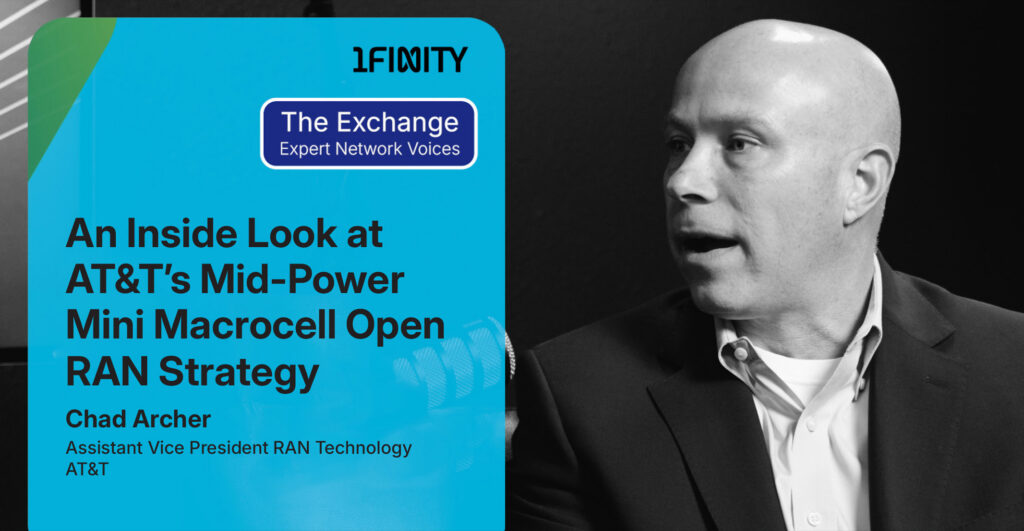
Chief among the early adopters of Open RAN is AT&T. I recently sat down with Chad Archer, AT&T’s Assistant Vice President for RAN Technology, to explore how AT&T is leveraging Open RAN to implement a mid-power mini macrocell strategy.
As I’ve discussed in this blog before, outdoor small cells are foundational to modern RAN design. As MNOs work to densify existing 5G capacity and coverage in dense urban environments, suburban pockets and high-traffic hotspots, small cells are evolving to meet various deployment needs. Like small cells, mini macrocells (think higher power outdoor small cells) are small and compact enough to comply with many municipal zoning regulations, and can be deployed on lamp posts, inside shrouds, in/on street furniture and on building walls. And with Open RAN, MNOs have greater choice to select the right radios for the mini macrocell deployment environment.
Why mid-power mini macrocells?
Typical small cells use low-power radios, around 5W per port. To increase coverage and capacity, AT&T collaborated with 1Finity to design a network of mini macrocells that are best described as medium power – not quite the high power of a macrocell, but also not the low power of a traditional small cell – at around 30W per port for frequency division duplex (FDD) and time division duplex (TDD) radios as part of their densification deployment.
With mid-power mini macrocell radios that are much stronger than the typical 5W per port, AT&T achieves not just capacity offload from existing macro deployments, but also densification for greater coverage and hotspot connectivity as well.
How is AT&T deploying mini macrocells?
To speed time to market as they densify their 5G network, AT&T is mounting the small cells on existing streetworks. These deployments might be anywhere from 12 feet to 30 feet off the ground, mounted on light poles, billboards or similar street furniture. In addition to having fiber and power available, AT&T required small, easy-to-install radios for the deployment.
Another important consideration for this deployment was the selection of an Open RAN solution to integrate into the existing multivendor network. However, while there are a lot of low-power small cell offerings and high-power macro radios on the market, the 1Finity 44R14 and 44R26 mini macrocell radios offered a compact medium power solution.
Similarly, the small form factor of these mid-power radios enables targeted deployment scenarios when needed in certain cities, such as fitting two radios inside a cooling shroud without overheating.
Why is Open RAN compliance important?
Prior to O-RAN standards, switching to another radio provider required either a complete rip and replace project, or waiting for the next G cycle, (e.g., 3G, 4G, 5G, 6G), which traditionally has been a ten-year cycle. But with Open RAN, AT&T can introduce a new radio unit (RU) provider and still use their existing distributed unit (DU) provider.
Likewise, introduction of a new radio vendor used to require bringing in a proprietary element management system (EMS) and operations support system (OSS). Since that is not the case with Open RAN, AT&T is able to choose exactly the right radio for the environment from any O-RAN compliant vendor, and they can fill in portfolio gaps where needed.
By leveraging Open RAN, the industry fosters healthy competition, driving improvements not just in performance and energy efficiency, but also in size and weight. Furthermore, this approach strengthens supply chain diversity, allowing AT&T to pivot if a particular vendor or region encounters operational headwinds.
Mini macrocell TCO advantages
In addition to the economic advantages of Open RAN, the broader mini macrocell layer offers its own set of competitive financial advantages. The compact form factor and mid-power capabilities of the mini macrocell radio translate into meaningful total cost of ownership (TCO) benefits as well, delivering substantial advantages.
With the compact mid-power units, AT&T has the flexibility to place nodes exactly where they are needed, provided there is access to power and fiber. This allows strategic traffic offloading, which enhances the performance of both the macro and small cell layers, ultimately resulting in a superior customer experience. From an engineering standpoint, that flexibility is vital. The smaller footprint of these radios simplifies the zoning process and ensures optimized placement for peak performance.
Compared to traditional low-power alternatives, the mid-power approach provides greater coverage and capacity to cover a given area with fewer total nodes. Fewer nodes leads to significant operational savings, including reduced power consumption and lower leasing expenses.
Open RAN Integration learnings
As they integrate their network of Open RAN mid-power mini macrocells, AT&T has gathered some important learnings. First, because fewer sites are required due to strategic placement of the small, lightweight radios, AT&T is able to speed their deployment timeline, bringing more sites to market more rapidly. This level of efficiency is vital in today’s mobile network environment, given the level of zoning requirements.
Typically, MNOs would roll out specific vendors in different geographies; however, because of the way that AT&T fully integrates multiple vendors in their Open RAN network, they are able to pursue a unique scenario with different vendor radios connected to the same DU via an open fronthaul.
Multivendor SMO advantages
The Service Management and Orchestration (SMO) framework outlined in the Open RAN standard enables multivendor control of RAN functions over standard interfaces. This provides AT&T’s network technicians and operations team a single platform to manage multivendor radios in their network.
With the development of targeted radio applications, or rApps, built on top of the SMO AT&T is able to create new apps that can be ‘ported over’ and quickly launched.
Plus, as more artificial intelligence (AI) tools and autonomous network capabilities become available, the network can be quickly upgraded – moving at the speed of software. Technicians will be able to not only get a view of each site, but they can also then quickly zoom out for a complete overview of all the sites in the network, allowing the operations team to optimize performance for the entire city, and maximize customer experience from the small cell to a macro level.
In a nutshell, all of these benefits stem from a mature Open RAN implementation, enabling AT&T to completely control their network and optimize it for the best possible performance 24x7x365. In fact, a recent benchmark study demonstrated that AT&T’s Open RAN deployment in Dallas provides outstanding performance, setting the stage for widespread deployments later this year to providing greater coverage and capacity in targeted areas.