
In the ever-evolving network landscape, IP over DWDM (IPoDWDM) has emerged as a game-changer. With promises of massive capex and opex savings, simplified architectures, and accelerated service delivery, IPoDWDM is more than a buzzword—it’s a strategic imperative.
IPoDWDM is redefining network architecture by merging IP routing with optical transport, delivering leaner, greener, more agile networks. This integration slashes power and space requirements—perfect for data centers and metro environments. Open standards like OIF, OpenZR+, and Open ROADM ensure vendor neutrality and flexibility. With breakthroughs in compact, energy-efficient optics, high-capacity pluggables, together with falling component costs, operators can now deploy faster, scale smarter and modernize their networks in an economical manner. Simply put, IPoDWDM isn’t just an upgrade—it’s a strategic shift towards efficient, interoperable networking.
Changing Landscape
IP-over-DWDM (IPoDWDM) technology has reduced the need for traditional transponders by enabling direct IP routers to be integrated with optical transport layers. This leads to immense savings, although transponders remain far from obsolete.
Router-based approaches effectively reduce the quantity of components in the architecture, and thus significantly reduce both capex and opex. Besides providing superior performance and spectral efficiency Transponders help to clearly demarcate the boundaries between optical and packet domains, ensuring operational clarity and aiding fault isolation, making them desirable for ultra-long haul and subsea deployments, at least for now.
IPoDWDM Challenges
Despite its many advantages, IPoDWDM introduces a new layer of complexity that network operators must navigate. Organizational silos between IP and optical teams can hinder seamless collaboration and unified management. Integrating solutions across diverse vendors and controllers presents interoperability challenges, while keeping pace with maturing standards and management interfaces demands continuous adaptation. These hurdles underscore the need for careful planning and cross-domain expertise to fully realize the benefits of IPoDWDM.
Management Interfaces & Standards
The Common Management Interface Specification (CMIS) is pivotal in enabling interoperability. This standard allows routers to manage pluggables from different vendors, avoiding lock-in and simplifying operations. Standards like OpenConfig and TIP MANTRA further enhance visibility and control.
1Finity’s Strategic Moves
1Finity has been actively engaging with global operators through architectural discussions and trials – both for IPoDWDM management and for in-house developed pluggables. The launch of the 1Finity P300, a coherent pluggable device, marks a significant milestone. Designed for integration with the 1Finity’s Ultra Optical System™ and Virtuora portfolios, it supports both OSFP and QSFP-DD form factors. Apart from in-house pluggables, most of 1Finity’s transponder portfolio is fully capable of supporting coherent pluggables.
Virtuora: 1Finity’s Management Solution
1Finity has extensive experience in managing and supporting Open, disaggregated solutions supported via its network management solution, Virtuora. TIP MUST certifications for both Virtuora NBI and SBI is a testament to 1Finity’s commitment towards Open solutions. Virtuora has vast experience of working with multivendor solutions, which has led to the creation of powerful frameworks to assist with third-party device and controller onboarding. With this background, Virtuora is poised to take on the challenge of managing IPoDWDM networks.
1Finity’s Virtuora platform offers flexible management across various deployment scenarios which can be customized to suit individual customer needs and preferences.
Management Aspects
There are three key aspects in terms of management – Optical, Router, and coherent pluggable.
Optical
With Virtuora Optical Orchestrator and OLS-Designer, all aspects of optical transport are covered. Virtuora caters to all management and monitoring aspects of the optical OLS including the optical line system and third-party transponder/muxponder hosting pluggable. OLS-Designer caters to reachability assessments and spectral optimization across these components in a vendor-agnostic fashion.
Router
Virtuora has built-in router management capabilities, but some operators prefer to manage routers through a separate controller.
Pluggable
Coherent pluggables hosted on a transponder/muxponder can be managed straightforwardly as a third-party transponder using OpenConfig. Virtuora understands the sensitivities around pluggable management hosted on routers. Based on operator preference, Virtuora can support pluggable management via router host or hierarchical/IP controller.
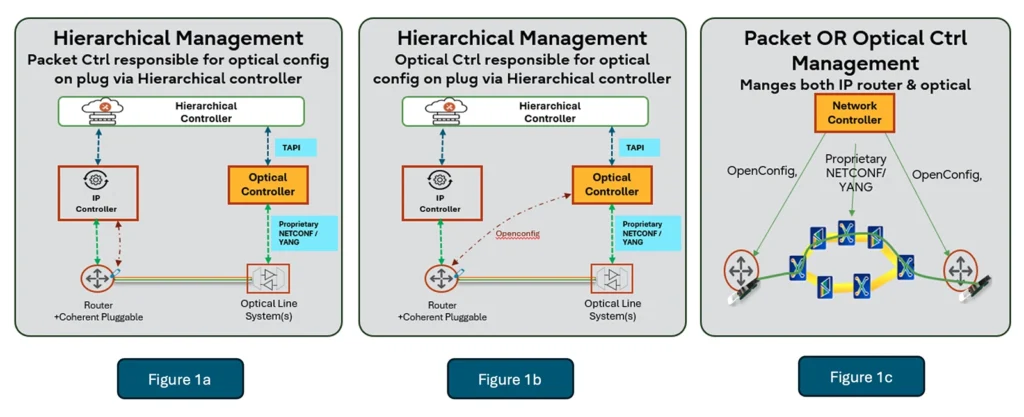
- Hierarchical controller/IP controller – Depending on the underlying router, Virtuora can play the role of hierarchical controller, as shown in figure 1c. If the hierarchical/IP controller belongs to a third party, then Virtuora can expose information via TAPI to the optical controller, as shown in figure 1a below. While solution 1a is clean and has clear demarcation between IP and optical teams, this approach introduces additional components and integration layers, which could delay troubleshooting and solution delivery.
- Router hosts – Virtuora can connect to a host management port and access information via Openconfig over NETCONF. Solution 1b below represents this solution, which demarcates the network based on the functional layer, where the optical domain is managed via the optical controller, while the IP controller continues to manage the router and electrical aspects of pluggables. Although this solution reduces the dependency of coherent pluggables on the host/host controller, it would need clear integration of shared management of pluggables between the IP and optical controllers.
Supporting a Unified Architectural Vision
Virtuora adapts to customer needs and helps in defining and shaping their architectural vision for a seamless network – one where they can move forward in their automation journeys. Virtuora has been deployed in solutions where it played the role of hierarchical controller managing Layer 0-3 networks, and it is in advanced trial phases for scenarios where Virtuora manages services over a multidomain, multivendor network using Virtuora Optical Orchestrator, providing unified management and monitoring capabilities.
Looking Ahead
The shift is clear. Coherent optics are behind adopted into transponders, with more rapid adoption into routers, reshaping revenue models and deployment strategies. Simultaneously, IPoDWDM is reshaping how networks are built and managed. With increasing customer interest, the momentum is undeniable. As standards mature and management solutions evolve, IPoDWDM will continue to drive innovation and efficiency across the telecom landscape. 1Finity is well placed with its Virtuora portfolio to manage the disaggregated multivendor network across layers to provide a harmonious management solution for the end-to-end network.
What’s in store for the future of IPoDWDM?
Find out in this white paper from Heavy Reading