
Are you ready for disruption when it comes to your network? From supply chain shocks to shifting customer demands, today’s mobile operators face constant pressure to stay agile and resilient in the face of constant change. That’s where Open RAN comes in—not just as a technical evolution, but as a strategic advantage. In this blog, we’ll explore how Open RAN extends resiliency across the entire network business and ecosystem, from supply chain to operations to long-term ROI.
In 2024, over 75% of our customer projects involved multivendor environments, including more than 750 customer deployments and integrations. Through this hands-on experience, we’ve seen how openness and disaggregation can transform not just networks—but the businesses behind them.
With this in mind, I can say with confidence that a multivendor track record and earned expertise are essential when building open, disaggregated networks. Multivendor support is a vital aspect to consider if you want to build resiliency in your network, the business that operates it, and the supply chains that provide the raw ingredients. This resiliency is more than technical, and it isn’t just about surviving disruptions; it’s about thriving through them. And multivendor expertise is its cornerstone.
Resiliency is inherently oriented to the long term, increasing value and therefore, ROI. And with its benefits of openness and disaggregation, Open RAN creates a more resilient network, business, and supply chain for network operators.
Open RAN Resiliency Beyond the Supply Chain
Open RAN extends resiliency into every part of the network. Supply chain resiliency is often the most discussed, largely because avoiding vendor lock-in brings with it the peace of mind of “backup” suppliers. But the supply chain is just one part of the story.
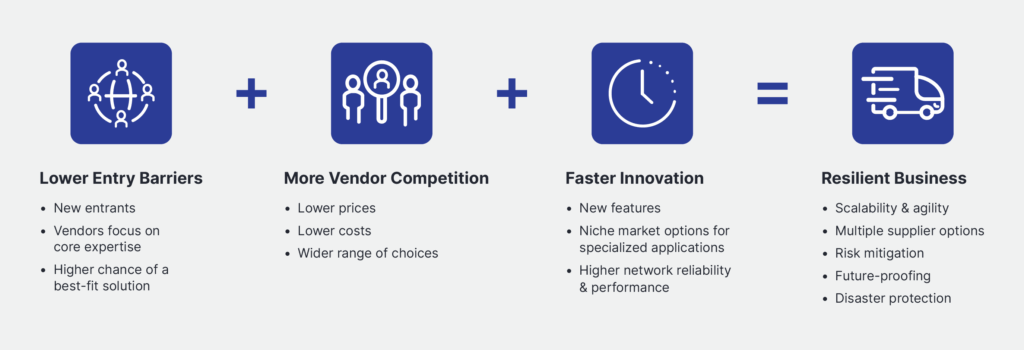
Open RAN also enhances overall resiliency at every stage of the network lifecycle, extending its benefits into deployment and maintenance, evolution, operations and maintenance, customer care, and profitability. By expanding freedom of choice across both hardware and software, Open RAN allows operators to source from a broader range of vendors. By lowering market-entry barriers and increasing competition, Open RAN spurs innovation and encourages development of specialized or niche-market solutions.
Open RAN also increases financial and practical flexibility, by enabling incremental growth and improvements that multiple vendors can deliver collaboratively. Open RAN further increases adaptability through a mix-and-match approach, where standards-compliant hardware and software from any vendor can coexist on the same network—freeing network operators to choose the best options for specific needs and scenarios.
A Wider Range of Choices
In the area of radio units, for instance, the use of open standards-compliant interfaces gives mobile operators more choices, including options tailored to specific deployment scenarios. This helps them grow their networks at their own pace and serve their entire footprint well. Given that many radio vendors specialize in specific types of RU, such as small or macro or indoor/outdoor radios, Open RAN’s multivendor support gives network operators easier access to the best-of-breed in each radio category.
Risk Mitigation: Resilience Against
the Unexpected
All infrastructure faces risk and must be resilient to unexpected events whether natural disasters, logistics challenges, economic and policy shifts, trade constraints, and labor shortages, or geopolitical instabilities. As an inherently multivendor architecture, Open RAN makes it easier to find alternative supplies. Additionally, use of AI/ML helps speed service restoration by accelerating troubleshooting and repair.
Undoubtedly, supply chain disruption is the most significant risk facing mobile operators. According to a 2023 TXO survey of over 90 global operators, 85% reported delays from supply chain issues, 45% saw network performance degradation, and 39% experienced revenue impacts. Supply chain risk is a survival issue; with concentrated vendor ecosystems and limited flexibility, many current network architectures cannot react to a serious disruption easily.
Flexibility & Agility to Adapt
By delivering greater choice and flexibility, Open RAN empowers mobile operators to respond quickly as needs or circumstances change. Scaling up or down is quicker and easier. And mobile operators can select vendors whose products the best fit the in-house skills of their deployment and operations staff, helping ensure smoother integration, faster troubleshooting and more effective day-to-day management.
The supply chain resiliency benefits of Open RAN have been widely discussed—especially in the wake of the COVID pandemic and global silicon/chip shortages and more recently, amid rising concerns about geopolitical instability. Open RAN has proved its value by helping network operators strengthen supply chains and minimize deployment disruptions. It has also enabled better access to spare parts for repair and maintenance, keeping networks fully operational with minimal downtime.
Vodafone’s Success Story
This perspective on Open RAN is not theory. It’s playing out among the top industry players. In 2023, Vodafone launched their first Open RAN deployment, replacing legacy technology with Open RAN in 2,500 sites across Wales and the Southwest of England. Their goal was “to provide much-needed diversity to the telecommunications supply chain,” as well as “to provide a platform for innovation that would otherwise not have been possible, offering new ways to enhance customer experience and introduce innovation at an accelerated pace.”
This example illustrates how operators can prove Open RAN’s value as a structural and strategic defense against disruption and regain control of their networks.
Vodafone isn’t alone in deploying Open RAN. Other operators—including AT&T, Deutsche Telekom, and Rakuten Mobile—are doing the same.
Open RAN Means Strategic Business Resiliency
So far, the conversation about resiliency in Open RAN has focused on resiliency of supply, but as we’ve explored, its impact goes much further. Open RAN’s resiliency effect goes far beyond avoiding vendor lock-in. Open RAN can fundamentally transform how network operators mitigate risk, increase adaptability and flexibility, and ensure long-term value creation.
Working with our Open RAN customers, we’ve seen firsthand how disaggregated architecture creates a ripple effect of resilience across an entire network ecosystem. When operators can mix and match best-of-breed solutions, scale incrementally, and leverage AI/ML for predictive supply chain management and network operations, they’re not just building networks—they’re building adaptive businesses.
Resiliency isn’t just about risk mitigation—it’s also about unlocking new efficiencies and competitive advantages. Operators that embrace Open RAN will find themselves better positioned to maintain service quality while controlling costs. The path forward is clear: Open RAN isn’t just a technical evolution, it’s a strategic imperative for any network operator serious about building sustainable, resilient operations for the decades ahead. Open RAN isn’t just a network architecture; it’s a blueprint for building adaptive, future-ready businesses. In a world defined by constant change, resiliency and sustainability are the new competitive edges. And Open RAN is how you build them.
Ready to Build a More Resilient Network?
Discover how our multivendor expertise and AI-powered solutions can help you unlock Open RAN’s full potential.